
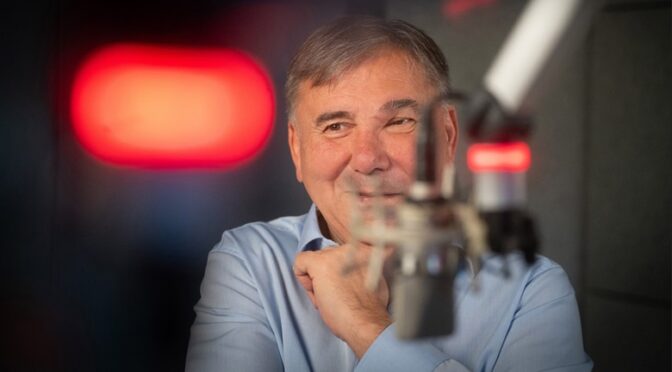
This is the annotated transcript of a conversation with political scientist Ivan Krastev, recorded in Vienna on June 1, 2026. An edited 52-minute German version was broadcast on Austrian radio station Ö1 on June 19, 2026. This is the transcript of the 120-minute original podcast version of our conversation.
Ivan Krastev, I have a quite modest goal for our conversation today. By the end of it, I’d like to understand the world a little better and Europe. Can you help me do that?
With great pleasure, because I’m going to help myself, because to be honest, I’m not sure I understand it anyway. (laughing)
In recent years, a line from Shakespeare’s Hamlet has been quoted again and again: “The time is out of joint.” It seems to capture a feeling that many people seem to share. And you are very often asked to explain this time, from leading newspapers like The New York Times to heads of government, and now by me. But why you exactly? How do you know what has gone wrong and how?
Listen, in a certain way, you can have the comic answer. I’m coming from a country which has probably more fortune tellers per capita than any other place in the world, so probably this is one of the reasons. But secondly, if we talk much more seriously, I don’t believe this is so much about my personality. It is very much about the fact that I’m part of a generation that has a radical change in our personal biography.
This is different than basically knowing things. This is basically going through an experience which probably is relevant to make sense of a world which is really changing dramatically in front of our eyes. And you should try to imagine how fast the world was changing for a 24, 25-year-old Bulgarian in 1989. This speed of change.The fact that on Friday you cannot believe anymore what you have been thinking on Monday. The idea that basically some of the major assumptions on which the world has been functioning have been challenged. I believe that this creates some type of an advantage when you ask people to talk about the world that is dramatically changing. And this is probably one of the reasons why people are interested to listen to somebody like me.
So let’s draw on this experience. In a widely discussed speech in Davos this year, Canadian Prime Minister Mark Carney said: “We are in the midst of a rupture, not a transition.” What is it that is breaking apart or has already broken apart?
Listen, I believe that it is a really much deeper kind of a rupture than normally people are discussing in Davos because Mark Carney – and this was one of those speeches that is capturing the zeitgeist – but he was talking about the breaking of international order in the way it was known after 1945 and particularly after 1989. But I do believe we’re going through something which is much deeper. There is a short science fiction story [from 1972] which is called “When We Went to See the End of the World”. And it tells the time in which suddenly people had traveled in time. So the tourist agencies started to offer the possibility that you can go and witness the end of the world. And all the short story is about the dinner party in which people are coming and sharing their experiences.
And there are two things happening. First of all, they went to see the end of the world, but they saw different things. One sees the world freezing, the other sees basically the world going under the water. The third saw the world burning out. But while they are talking about all this, on the television, there was a report of the president being killed, of major riots in the city. So, in a certain way, the end of the world was coming in front of their eyes, but they’re kind of too busy to see it.
I’m saying this because, in my view, one of the things that happened – and probably it’s the West, not everywhere else – is that this feeling that you’re living in a kind of the end times. This kind of disappearance of a positive future, from our perspective of the world, is something that I found the most important. And this is what, basically, in my view, Carney meant when he said, it is a rupture, not a transition.
„If you ask me how I feel the world, it’s very much like a vertigo.“
Transition is a movement from one stage to another. But this next stage, you can describe, you can like or dislike, but you know basically how the next destination is going to look like. While we see that something is ending, it is not very clear what is beginning. And I do believe this is at the heart of it, and this is why, at least for me, if you’re going to ask me not how I understand the world, but how I feel the world, it’s very much like a vertigo. [Czech writer Milan] Kundera has a great definition of vertigo. He said: Vertigo is not the fear of falling. Vertigo is the desire to jump against which you’re struggling.
But why would we have the desire to jump?
One is because everything is changing and we don’t understand. The life as we know it is not there anymore. And it’s not only politics. By the way, people, I believe historians, are going to come back in 10, 15 years. And they’re going to write much more about the effect of Covid and what happened in March and April 2020, when suddenly, for weeks, the world was frozen. Because this dramatically changed our imagination. Imagine something that you believe is impossible became possible. And as a result of it, your political imagination is changed. For example, imagine that you are an environmental activist. And all your life you wanted all the planes to land on the same day. And they landed. Or if you’re a right-wing activist and you dreamed that all borders are going to be closed on the same day. You were dreaming about this, but you believed that this was not possible. And this was possible. They were closed on the same day all over the world.
And I do believe this idea that certain things that were impossible happened is changing very much the way we see the world, the way we understand ourselves. And not simply because of the pandemic. But suddenly, the idea that the impossible can happen starts to go into every way of life. For example, if you look today and read the newspapers, there is no connection between the economy section, I mean market section, and the political section. If you see the performance of the American market, you’re going to imagine that this is the most optimistic kind of world in which we are living. The stocks are going up, people are making incredible profits. If you try and see the political sections, you’re going to see that the world is going to die every minute. It’s going to be either climate or nuclear war or something else. When you see how people feel, they feel totally disoriented, at least in the West. And I do believe this fact, this kind of total disconnect between different parts of our life… Quite often people say: I feel personally okay, but I’m very much worried, for example, about my kids, how they’re going to live. I’m much more worried about how society is going to look like.
„In a certain way, you have the feeling that you’re invaded from everywhere.“
And my major argument on this – I could be very much wrong – but I do believe that two things that were very much structuring our world on a deeper level have changed. One is we always knew that people are mortal. We didn’t like it, but we have been living with this and basically dealing with our mortality is what produced our civilization. Now you go to Silicon Valley and you’re going to see all these people who genuinely believe that they will never die. So they want to live forever. But not to live forever in the memory of the people, but in their apartments. And on the other side we believe that we are mortal, but we believe that there are certain things that are immortal. For example, our nation. I’m going to die, but basically I’m going to be remembered and so on. And this has changed. And by the way, the fact that you’re going to have much more people who do not have children is also affecting this. Because you see the world differently. So the mortality of nations and the possibility of the immortal individual – this is a structural change.
And then you have everything else. AI … I was very much impressed by a conversation that [New York Times columnist] Ezra Klein has with [Israeli historian Yuval] Harari, in which Harari made a point which is not new, but in my view is important. He said: AI is not an instrument. It is an agent. All our other technological discoveries historically have been instruments, things that are helping us to do things differently. But now you have an agent, and this agent is in a totally different relation with us. And in a certain way, you have the feeling that you’re invaded from everywhere. Some people believe that they’re invaded by migrants, others fear that they’re invaded by machines. And in a certain way, the way the world as we knew it is not there anymore. And I believe this is behind everything. Politics, economics. People have different fears. People have different dreams. But this sense of rupture is what, in my view, Carney has kept.
But on the other hand, the experience that the impossible is suddenly possible could give you hope and optimism and not the sense of vertigo and the wish to jump.
The things that we fear most are the things that we hope for. And AI is the best example of this. On one level, AI can create really miracles when it comes to medicine, when it comes to economy. So there are people who hope. But this is, in my view, a characteristic of our time. The things that we are most hoping for and the thing that we most fear is the same thing. It is not that the evil is going to prevail over the good. In a strange way the evil and the good are the same thing. AI, if it is going to realize its potential and help humanity, is our best hope. On the other side, if it is going to change human nature, if it is going to make humanity kind of useless, if it basically is going to destroy the distinctiveness of the individual, this is something that, of course, you cannot not fear because this is your species. And I have seen this before on a lower level.
The same was with opening of the borders. You go in Eastern Europe, you ask people, what is the best thing that happened to you after 1989? And they say, the opening of the borders. What is the thing that scares you most? The opening of the borders. Because opening the borders means that I can get out, I can have an opportunity that I didn’t have before. But opening the borders means that other people can come and probably I’m not going to be as happy. So this kind of, the best and the worst being the same thing and you don’t know in which direction to go, in my view, is a distinctive characteristic of the time in which we are living.
You mentioned the pandemic now and you mentioned AI as causes for this rupture. You didn’t mention the war in Ukraine. But still you said in several interviews that it was the Russian invasion into Ukraine which actually ended the 20th century. What did you mean by that?
Listen, it is critically important because any big war is a major change. And in the case of Russia-Ukraine, this is a big war between two big states. The number of shells – and I’m not even counting drones – that have been fired last year was on the level of 1942. So we’re talking about something big and thousands of people dying.
But also, I do believe that Russia’s Ukrainian war was the end of the 20th century because suddenly all the identities that have been created in the 20th century disappeared. Europe was very much based not on a certain vision of the future, but on a kind of rejection of a certain past. Because what kept Europeans together was the common experience of the destruction of both World Wars, and particularly World War II. And now what happened with Russia’s war in Ukraine is that first, many of the language on which we have this shared experience have been totally destroyed. Listen, when the Russians start talking that they’re there to denazify Ukraine. All the kind of talk about the common understanding of Nazism has become totally meaningless. You are weaponizing something that was so central for Europe’s understanding of its history for totally instrumental reasons, trying to explain the war that otherwise you cannot explain. Secondly, which in my view is also changing dramatically – and we’re seeing this more and more – you cannot distinguish anymore when you’re basically a drone operator between a war and a video game. This is dramatic. This is the easiness of killing. And this is particularly strong for the generation that was socialized in video games.
„All major identities that have been built in the 20th century are not there anymore.“
One of the things that I really believe people are not realizing is that to a certain extent this war was not simply an imperial war. It was very much in demography. President Putin is totally obsessed with demography. There are not enough Russians in the world. By the way, as you know, he’s quite obsessed with his own kind of longevity. 26 billion is the anti-aging industry in Russia. And as a result of it, suddenly, you end up with a time in which history is totally deprived of its major characteristics. In a certain way, you’re destroying Kyiv and Kharkiv. At the end of World War II, all the consensus was that this should not happen ever again. And you’re doing this and trying to pretend that you’re fighting the Nazis? So we don’t have a language anymore to talk about this.
And the other thing that is happening: In my view, after World War II, there were four countries that were very exceptional. And we all agree that they were exceptional, it was not the exceptionality that everybody believes about themselves. It was the Soviets and the Americans, and it was the Germans and the Israelis. Because the Soviets and the Americans were basically the two ideological states that framed the Cold War. That was very much about the future and to whom the world belongs.The Soviet Union disappeared, but also the American Cold War identity is over. In a certain way, President Trump makes it very clear that he believes that liberalism is not the strength, but the vulnerability of the United States. And then Israel, in the eyes of many people, particularly outside the West, stopped being perceived as the victim and very much was perceived as somebody who is acting in a way that is totally unacceptable.
And then you have Germany. Every crisis that happens is becoming the crisis of the Germans‘ World War II identity. It was so difficult for the Germans to imagine German tanks on the territory of the former Soviet Union. It was very difficult for the Germans to talk about the war in Gaza. It was so difficult for the Germans to talk about their disagreement with the United States, because all this is what Germany was about. And I’m saying this because we’re in a period in which all major identities that have been built in the 20th century are not there anymore. And all the major lessons that we have learned from the 20th century suddenly start to look irrelevant.
But did this have to happen? For a long time, historians moved away from the idea of the “Great Man Theory”, according to which a couple of very powerful individuals determined the course of history. Instead, they pointed to long-term structures and developments. But would the world really look the way it does today – and as you just described it, if, let’s say, Vladimir Putin and Donald Trump had chosen different professional careers?
It is very interesting because in Francis Fukuyama’s book, The End of History and the Last Man, on the last page, Donald Trump appears. And basically the major argument of Fukuyama is: Is it going to be enough for people like Trump, who back then was a kind of a business celebrity, to have his ambition for recognition satisfied simply by being a rich man and being a TV personality? And it turned out that the answer was no.
Fukuyama’s argument was people will get bored.
Exactly. But in a certain way, they’re not bored, they get overexcited. And one of the interesting things, particularly when you’re talking about people like Trump and Putin, is that normally political scientists try to see mostly the similarities between them. But there is one important dissimilarity, which in my view is important for our conversation. And this is the understanding of time. If you listen to President Trump, the longest future that he talks about is several weeks. He’s going to stop the war in Ukraine in a day, if you remember, and then basically when he’s negotiating with the Iranians, everything is about two weeks, four weeks. If you listen to President Putin, everything is in centuries.
He’ll go and, by the way, read something from the 9th century in order to basically write an essay on what he’s going to do in the 21st century. Suddenly, on one level, you have this narcissistic idea of time when nothing before you matters and nothing after you matters. And on the other, you have this political leader who basically lives in a total eternity, where in a certain way there is no history, because if the 9th century is as important for shaping your decision as what is happening in your society now, something is also wrong. And I do believe this kind of collapse of a common understanding of time is something that is really interesting.
„The fear that you don’t understand why people do not want to reproduce themselves…“
And by the way, this has something to do with demography. It has something to do with the fact that we have this major collapse of birth rates everywhere. Democratic countries and authoritarian countries, China, for example. And then you have rich countries and poor countries. And nobody knows now exactly how it happened. There is a theory of demographic transition and it is well known and it is very much about the education of women and other things. But now you expect a country like Finland, which has a generous social policy, a very egalitarian society, women are really respected. Suddenly, overnight, they’re losing a lot. Simply, basically, they don’t have children. And Turkey, which collapsed over two or three years. And the fear that you don’t understand why people do not want to reproduce themselves is a major issue in such different places, in such different environments. And by the way, these are individual choices of people. You cannot blame people for taking one or the other decision. But why? And in my view, this is one of the paradoxes also of AI. AI can solve a lot of problems that could not be solved before. But AI and, for example, big data, they never answer the question why.
But let me come back to my original question. How big is the role of an individual politician in these days? Would the world look different without Vladimir Putin and Donald Trump? I mean, the war in Ukraine probably wouldn’t have happened, or would it?
Listen, I also believe that people matter. People matter with their experiences. People matter also because in a moment of crisis, it’s much easier to trust a person than an institution. There are going to be certain types of structural change even without these personalities, but they could have taken a totally different shape.I have been thinking quite a lot, particularly about President Putin, and one of the most important things is that, for me, the most important part of his experience is not even so much the KGB background, which for sure is important, but the fact that he was outside of his country when his country was changing. During perestroika, he was a Soviet spy in East Germany, so you cannot imagine how difficult it is to understand your own society if you are not there when that society goes through dramatic change.
You know some people, and then you read in the papers that they’re saying things that you don’t expect from them at all. So as a result, for him, the collapse of the Soviet Union was a mystery. He cannot understand why it happened. For him, this was a conspiracy. It was a betrayal. He didn’t understand why all these other KGB officers didn’t try to do something more to protect the country. He didn’t understand why nobody committed suicide after the project collapsed. So in a certain way, he was not understanding what happened to his country. And then, out of his anxiety, of not understanding what happened to the Soviet Union, he starts to build his own view of the world.
But is his aim now to rebuild the Soviet Union?
No, no. This idea that he simply wants to rebuild the Soviet Union is not true. If you listen to his famous speech—and the most famous of his speeches is not the day when he attacked Kyiv, but two days earlier, when he recognized the separatist republics—this was not a speech of a Red colonel. This was a speech of a White general. He was talking about the Soviet Union as being to blame for the state in which the Russians are. He was calling Ukraine a state basically created by Lenin and populated by Nazis. He was very much obsessed with the survival of Russian civilization. And he’s thinking very much in civilizational terms. But it’s not about the Soviet Union or communism. This is about Russia and Russia’s place in the world. He has this famous quote: „If there is no Russia in the world, this world has no meaning to exist.“
And then the problem is: What was the major threat to Russia as a civilization in his view? And paradoxically, there are three things. One was, of course, the military threat that he likes to talk about—NATO and so on. We don’t know how much he believes it. Russia is a nuclear power. So from this point of view, the idea that you can feel so threatened while being a major nuclear power does not come easily, particularly for those of us who are not a nuclear power. But of course, he has seen a nuclear power collapse – I mean the Soviet Union. And this is why he didn’t understand how it could happen.Secondly, it was about Russia’s identity. And then, of course, one of the important things is his problem with the children. What is happening to our children?
„This fear that there are going to be too few Russians in the world, became critical for Putin.“
There is a famous American TV show called The Americans. It was very famous in the U.S. It is a classical Cold War spy novel. It takes place in the late 1980s. Two Soviet spies are living as illegals in the U.S. They stay there for decades. They have children and so on. The story is that when they have to go home, their children do not go home because their children are Americans. These children basically stayed in the United States while the parents had to go home in order to avoid being arrested. I have the feeling that Putin has this fear that suddenly all Russian children became Americans. They were totally westernized. This is, by the way, also very much the experience of the Russian elite, who sent their children to private schools in places like London or Vienna. And then suddenly they don’t recognize their kids. And not because they talk about democracy, but because of social issues, gay rights and so on. So our kids are not our kids. And secondly, Ukrainian kids are our kids because Ukrainians are Russians.
Nobody can understand the meaning of this war if he does not understand the idea of the kidnapping and abduction of children and the adoption of these children. Nobody is going to understand Putin’s relationship to the West if he does not realize that the first openly anti-Western legislation adopted in Russia was the famous Dima Yakovlev Law [of 2012], which banned Americans from adopting Russian orphans. I do believe this idea of the children, this fear that there are going to be too few Russians in the world, became critical for him. So before the war, in 2021, on several occasions, without being asked, he was talking about the fact that according to demographic projections, there should have been 500 million Russians in the world. But because of World War II, because of the civil war, because of this, because of that, now there are only 143 million. So this idea that there are not enough Russians in the world means that Ukrainians should be Russians, Belarusians should be Russians. And this is why this war is very different from, for example, the Yugoslav wars, where you’re trying basically to kill the children of others because you’re afraid that otherwise they’re going to seek revenge for the killing of their parents. Here you want to adopt the kids of others.
Not long after the start of this war, in February 22, we did an interview together, and at the time you said the war would certainly not end before the American presidential election in November 2024. Back then, this was still more than two years away, and I found your prediction extraordinarily pessimistic. Now it’s mid-2026, and this war has been going on for four years now. Will it ever end?
It is going to exhaust itself, but the major story is what exactly is going to end. I do believe that at some point there is going to be a certain type of freezing of the conflict, a certain type of cessation of hostilities. But listen, the end of fighting is not peace. And this is one of the major things that is happening. Both sides are very much exhausted. Demographically, this is also true for Ukraine, dramatically. For every baby being born in Ukraine, three people are dying. They are exhausted economically, but also psychologically. You know, this war is longer than the Soviet-Nazi war. And suddenly people start not to know – they have forgotten what it means to live in peace. You’re going to have, in my view, a certain escalation in the next months because the Russians will try to make one more effort to break the Ukrainian defenses. At least from what we get from the battlefield, it’s not going to work. And then I would not be surprised if in autumn or the beginning of winter there could be some ceasefire, for different reasons. Both sides can decide to do it.
„At some point President Putin will have to decide what the cost of this war is, even for him.“
But how stable is this ceasefire going to be? How much is it going to create a sense of peace on both sides? That is a totally different question. And honestly, for President Putin, this has now become very personal. There was an interesting article in The Economist, an anonymous article written by a former very senior Russian official, who said something that I found believable, because this is also what I’m hearing from Russia: Suddenly, the Russian elite starts to talk about the war as his war. It does not mean that they don’t want Russia to win. It does not mean that they are against it. But some of them want it to finish, regardless of how. Others want Russia to become much more destructive and to try to win, regardless of how much it costs the country. But we’re in a situation in which nobody is happy with President Putin. It does not mean that there is going to be a coup. And to be honest, I always become very ironic when Western newspapers start talking about a coup or about his health as if we know something. But the story is that there is alienation from the war. And it cannot continue like this forever.
Because one of the things people normally do not realize is that Russians were more surprised by the war than many people in the West. By the way, Russian elites were not prepared for this war. A large part of the Russian elite, particularly the financial elite, believed that he was simply bluffing, that he was trying to pressure the West in order to get certain things. So when the war started, during the first month, the Russian situation was one of total disorientation. And then they were mobilized and sided with their country. It was a case of „My country, right or wrong.“ And some of them also felt that they had no real alternative because many of these elites had already been sanctioned by us. But then the first two years – and this is interesting, and very few people know about this – economically, the first two years of the war were not bad for Russian businesses, including small and medium-sized businesses. First, because Western companies disappeared, so there was market space. But secondly, because Putin was so afraid of the impact of sanctions that he told the tax inspectors to stop harassing companies, which meant that corruption pressure was dramatically reduced. Because in Russia, when the tax inspector comes to your company, you’re going to pay. And then for two years there was this kind of excitement on the business side: We’re not doing badly, we’re doing fine. And of course, they have an incredibly competent central bank, which helped them deal with this first phase. All this ended two years ago.
Now the budget deficits are a real issue. The pressure on companies is big. The redistribution of property in Russia is amazing. The day the war is over, we are not going to know the names of the ten richest people in Russia. All the names we knew before – including, in my view, some of the personal friends of President Putin – probably are not going to remain in the top ten, because there is a huge redistribution of property. A new generation is coming, particularly Siloviki from the Ministry of the Interior, the Prosecutor’s Office and other institutions, who are acquiring enormous assets. So this is something that is changing the country. And I do believe that at some point President Putin will have to decide what the cost is, even for him, if this war continues forever. It’s very difficult. To be honest, it’s very difficult to talk to somebody who has met the president during the last month. And it’s not very clear where he stands. I was very much impressed by his conversation with President Xi when the microphone was hot and they started talking about organ transplants and the fact that they can live to 120 years. Because if President Putin believes that he’s going to have 20 more years of active life, his view of politics, of war, of the world, is totally different than if he believes that he is in his mid-seventies and should think about his legacy.
But you don’t think he really thinks that he has another 20 years?
This is the major weakness of the regime because we don’t have any clear idea about the physical health of the president. By the way, we also don’t know what it means that somebody is going to live till 120. We don’t know how his mind is going to work. We don’t know how relevant his experience is going to be. It totally doesn’t matter what I think. If he believes it, probably he can die next year. But if he believes it, this changes dramatically how he sees politics and the world.
But is it plausible that he believes that?
It totally doesn’t matter what I do think. If he believes in it – probably he can die next year, but when he believes in it – this is changing dramatically how he is seeing politics and the world. I do believe that when you are so high in power for such a long time, many things are plausible. I always had, before the war, conversations with colleagues who were very much convinced that the Russian elite and President Putin himself were so corrupt that the war could not start because they would not want to jeopardize their bank accounts and their position in Western business. And my argument always was: You should be a very underpaid assistant professor at some Western university to believe that the leader of a nuclear power thinks primarily in terms of his bank account.
Doesn’t he? He obviously wanted to get rich and became rich …
No, no. He’s totally corrupt. There is no doubt about this. The problem is what motivates you. And when I spoke about the difference in time horizons between Trump and him, there was this joke that there were only three people he consulted when he decided to start the war in Ukraine. And these were Catherine the Great, Ivan the Terrible and Peter the Great. But in a way, this is true. Because in a certain way, he believes that the only people who understand what he’s doing are his historical predecessors. This is this eternal conception of time.
„Being president of a great power for twenty-five years changes you dramatically.“
I do believe these people are living in a different conception of time. And the thing that really worries me is that when I see some of the Silicon Valley super-rich, and when I see people like Putin and some other world leaders, they see the world in the way the Greek gods saw the world, at least as we know them from Greek mythology. They don’t see themselves as being the same type of beings as other people. This idea of immortals and mortals – not in a physical sense – starts to exist because of the power of technology, because of seeing the world differently, because of being president of a great power for twenty-five years – it’s changing you dramatically. Everything is different.
I was talking to somebody who said … because they were asking, „Oh, you’ve met him. How do you believe he’s doing this and that?“ And I said: Do you really believe that if you met Stalin in 1935, you would know how he felt in 1944?
The war experience is so transformative. It is so different. Hundreds of thousands of people have died, Russians, because of him. This was a war of choice. We can discuss many things, and I do believe there were many problems with Western policy towards Russia. But it was a war of choice, in the same way that Trump’s war against Iran is a war of choice. It was not something they were forced into.
In a major speech in Vienna, you recently said: “Making war unthinkable was Europe’s greatest achievement. It has now become Europe’s greatest vulnerability.” But why? Is it really realistic that someone starts a war against Europe? And who?
I do believe that what happened, particularly after 1989, was really extraordinary. Ordinary Europeans knew that there were wars in the world, but they could not imagine a major war in Europe. And from this point of view, even the Yugoslav wars were very easily forgotten because people said: This was from the past. Yugoslavia was simply that part of Europe which was not really part of Europe when the war started. They were living in their own specific past. But now, first of all, there is a war. Hundreds of thousands of people are dying. Secondly, on one side, there are Western weapons, because this is the only way for Ukraine to defend itself. On the other side, you have the constant rhetoric from Russia that they are in a war with the West, that they are in a war with NATO, that they are going to nuke this or that. And of course, different Europeans assess the danger differently. I’m not sure the Portuguese or Spaniards believe that war is at their doorstep. But go to the Baltic states or Poland, and they are living in what feels like a pre-war situation. I believe it was [Polish] Prime Minister [Donald] Tusk who said that he feels like it’s 1939. Does this mean there is going to be a war? To be honest, we don’t know. Probably most major conflicts happen because of miscalculations.
But still, could there be such a big miscalculation that Putin, after the war in Ukraine, starts another war against a NATO member?
I don’t believe that Putin is interested in a major war. But at the same time, he is probably interested in showing Europeans that NATO is dead and that Article 5 does not work. I don’t believe that he wants to get Tallinn or Riga. But if he decides to do something provocative in order to show that Europeans are not going to react … For example, Narva, thirty kilometers from the border [in Estonia] – you can always say that something has been done against the Russian population there and move in thirty kilometers just to show Europeans that they should start talking to the Russians because they cannot rely on the Americans.
„If nobody reacts, the European Union is going to collapse.“
But then countries like Poland, the Baltic states, even Germany, being afraid and trying to show him that this is not the case, decide to move to [the Russian enclave of] Kaliningrad. Not by responding directly in Narva, but by saying: “If you do this, we are going to react elsewhere.” And then we are in an escalation spiral that is out of control for both sides. Because in a certain way, both sides are trying to make a point. Because don’t forget: If he does something like this and nobody reacts, the European Union is going to collapse. The Baltics and others will say: “You betrayed us. We cannot rely on anything. How are we supposed to continue?” And the major idea of such a type of operation is not to control territory but to create such a level of rupture within the European Union and NATO that Russia’s relationship with Europe changes fundamentally. And because Europeans – and Americans know this – and because Europeans in particular believe this would be truly dramatic for Europe, you can expect certain reactions. But every reaction creates a dynamic of its own. I don’t believe that either side is genuinely interested in a war. Nobody, by the way, can really imagine what such a war would look like. But what has changed, and this is dramatic from my point of view, is that this is Europe’s major vulnerability because it forces us to see the world completely differently.
Before, we saw the world very much as a positive-sum game. The idea was that interdependence is the major source of security. We are going to trade so much with the Russians that Russians attacking us would mean attacking themselves. This is what Germany did with the French. This is what they did with the Poles. With the French and the Poles it worked. With the Russians it didn’t. But then suddenly, when the war started and when the Russians cut the gas supplies, all your relationships start to change. You begin asking: Who else are we dependent on? And then this is changing your relationship with China. Should we really want these dependencies? And now even with the Americans: Are we becoming too dependent? And then suddenly you realize – and this was the paradox of the war – that Europeans had convinced themselves, agreeing with [Bert] Brecht, that we feel pity for a country that needs heroes. Then comes the war in Ukraine, and the Ukrainians, who were the much weaker part and everybody expected them to be defeated within six weeks, fought for themselves. And this was a very spiritual moment. So we started envying the Ukrainians.
Before the war, you would normally see European flags in Ukraine during the Orange Revolution or in 2014. Suddenly, you had Ukrainian flags all over Europe. Because the idea was: They are ready to die for their country. Are we? And then we started seeing opinion polls saying that we are not prepared to die for our countries – which, to be honest, is complete nonsense. Because before the war, Ukrainian opinion polls were not very different from German opinion polls.
And this is the lesson of war. First of all, you don’t know what you will do once war starts. Because it is such a transformative experience. Imagine [Ukrainian President Volodymyr] Zelenskyy had accepted Western advice and moved to Lviv. The Russians would have taken control of Kyiv. We would probably be living in a totally different situation today. So in moments of radical change, individuals matter. Individuals with power matter. Individuals who can capture the public imagination matter. We have so much in Europe convinced ourselves that everything is about institutions, structures, deep economic reasons. So we are surprised to see something our grandparents knew very well: People matter. Individuals matter.
So one big vulnerability of Europe is ignoring the possibility of war. But isn’t there an even greater vulnerability: that despite all the lessons of the 20th century, so many people once again seem to believe in „strong men“ – speaking of personalities – in nationalism and political extremism, and that our democracies appear to be far less stable internally than we believed for a very long time?
I totally agree with you. There is this famous saying that ships in the ocean do not sink because of the water around them. They sink because of the water inside them. And from this point of view, everything is changing. Listen, nationalism has played different roles in European history. Don’t forget that liberal nationalism was critically important in creating European democracies.
But it somehow got out of hand.
Yeah, and then it got out of hand. So in a strange way, Europe came to see itself very much as a post-national project. And this was very important. If you go back to people like my great-grandparents in Bulgaria, they were totally uneducated, but all of them spoke, to some extent, two or three languages. They spoke Bulgarian, but they also spoke some Turkish because we were part of the Ottoman Empire, and probably some Greek because of trade and so on.
And then came the generation of my parents, and in a certain way the nation-state disciplined people.You should speak just one language, your own language. It was very much about discipline. So for my generation, learning a second or third language was almost an achievement. And then I look at my children, who speak five or six languages, and you don’t even know where it comes from. Why is it so easy for them? This opening-up was extraordinary.
„How do you have a nationalism that creates community without destroying everybody?“
But at the same time, the question becomes: Where is your home? And this sense of home is, in my view, extremely important. Is there a place to return to? I spoke to many people voting for the far right in Western Europe. And when you talk seriously to them, instead of accusing them of this or that, you start to realize that many of them say: “All these migrants coming here, at least they have a place to return to if they don’t like what they see. But where are we supposed to go? Our country is no longer our country.” But there is no way back. And paradoxically, far-right parties tell them: “Vote for us and we are a time machine. We will bring you back to how your country used to be – demographically, economically, culturally.” And this is a very powerful story because we live in a homeless world. Suddenly, it feels as if nobody is truly at home anymore.
Home is an interesting concept because home is a place you feel you understand, and also a place where you feel understood. And now we live in a world where we are no longer sure that we understand what is happening, and many of us feel profoundly misunderstood. I do believe this longing for home has become a major political force. Even resistance to Trump has become part of this. You can see this in classical liberal politicians like Mark Carney himself. On the other hand, you see classical European nationalists like the French far right saying: Okay, but you cannot really leave Europe, so what exactly are we offering? And then you see what happened in Britain after Brexit. So this whole story – what is the new role of nationalism? How do you have a nationalism that creates community without repeating what nationalism did in the 20th century, namely destroying everybody – has returned.
But what is actually the appeal of these populist and far-right parties? They promise to be a time machine and to bring back a time when there was a better future. But how can anyone believe this promise?
Sorry for mentioning too many popular films, but there is a Norwegian TV series called Beforeigners. Not a great series, I should confess, but I find the premise great. Suddenly, in present-day Norway, people arrive – but not from other countries. They arrive from previous periods of Norwegian history. Vikings show up, nineteenth-century Norwegians show up, and they all have to be integrated into contemporary society. And my view is that something like this has happened to our own societies. Our societies are deeply divided over which past people want to return to. Different people have different utopias. In the past, utopias were located in the future. Now they are located in the past. Many of these utopias are based on nothing. Many people who want to return to the 1950s have no real idea what the 1950s were actually like. By the way, it is mostly men who are nostalgic. There was an opinion poll in France asking women what period they would like to return to, and they answered: None. We don’t want to go back. For very good reasons. But my point is that different people feel they are losing different things. And this, in my view, is one of the major differences between Europeans and, say, Indians or Brazilians. This sense of disruption exists everywhere. The collapse of the international order is a global phenomenon. But in other parts of the world, people are much more fascinated by the opportunities. In Europe, we are much more fascinated by what we are losing. Different people believe they are losing different things. On the right, the standard narrative is: I am losing my culture, I am losing social cohesion. To be honest, people of our generation often feel we are losing part of our influence as men of a certain age and position. But others feel threatened too. Women, for example, suddenly see issues returning that had previously seemed settled: abortion and many others.
„We live permanently in a state of emergency.“
So this idea that everybody is trying to defend something they are afraid of losing means that the future disappears. The future becomes something we fear. I have thought about this a great deal. There is something dramatic about it. Because modernity was built on the assumption that the future comes first. The future was going to be different from the present, and we felt optimistic about that. Different people were optimistic for different reasons. And I may be wrong, but I believe one reason the Cold War never became hot was that both the Soviets and the Americans believed that the future belonged to them. The Soviets because of Marxism, which told them capitalism would collapse because of its contradictions. The Americans because of [U.S. diplomat George F.] Kennan’s containment theory, which basically said: time is on our side. Wait for the contradictions of the communist regimes to emerge and we will win. What this meant was that both sides believed that if there had to be a war, it was better for it to happen tomorrow, because tomorrow they would be stronger.
What worries me about today’s world is that many people believe they will be weaker tomorrow. This is a dangerous world. Some people fear climate change. And for understandable reasons. If you read some of the projections, by the year 2100 up to three billion people may no longer be able to live where they live today. Whether these projections are right or wrong, I don’t know. But they capture our imagination. And the same is true of demographic projections. How many children there will be. How old our societies will become. As a result, something fundamental may have changed in democratic politics. We live permanently in a state of emergency. If I believe that unless a decision is taken today, tomorrow will be too late, then losing an election is no longer an option. Because the charm of democracy was always that you could postpone things. You could lose today because you knew you could win tomorrow. Decisions that were not taken today could still be taken tomorrow. But suddenly time has shrunk. Everyone tells you: Now or never.
And then every election begins to feel like the last election. I don’t think Austria is the best example of this. But look at the United States, or even at Poland in Europe, societies that are genuinely polarized. Many people there believe that if something is not done today – whether on climate, immigration or something else – tomorrow will be too late.
But on the other hand, we see more and more elections, and many major democracies almost seem ungovernable. Britain’s Prime Minister Starmer, who won a landslide only a year ago, already looks like a dead man walking. In France, no prime minister seems to survive more than a few months. In Germany, people are already speculating about the end of Chancellor Merz. And what state is Europe in when the most stable government is in Italy? And the prime minister there is a former fascist.
Yeah. My feeling is that we are really witnessing not simply the rise of one party and the decline of others. Our political regimes are going to be transformed. And there is both good news and bad news in this. The good news is that democratic regimes have changed many times before. These are experimental regimes. At the end of the day, in my view at least, the major advantage of democracy compared to authoritarian regimes is that it contains a mechanism of self-correction. You can end up with very bad people in power. Very bad policies can be implemented. But if you are unhappy, you know what you can do. In authoritarian states, you may be lucky for a while and get policies you agree with. But if things go wrong, you don’t know what to do. Because revolution is simply too costly. And here is the paradox: On one level, people are deeply unhappy with democracy. But when it comes to the basic principle of democracy – that governments can lose elections, and when they lose elections, they leave office – people value this enormously. Hungary is the best example. Eighty percent of people go out and vote because they believe change is possible.
„We have started treating politicians the way we treat delivery services.“
The problem is that everything is changing so fast that we no longer understand why some governments are performing so badly. I don’t believe the current British prime minister is a particularly gifted politician, to put it mildly. At least not the most charismatic politician I have seen in my life. And I don’t believe Chancellor Merz is the politician of my dreams either. But do you really believe that in one year they can achieve everything people expect? One of the things that is happening is that our time horizon has shrunk. Part of this is technology. In a certain way, we have started treating politicians the way we treat delivery services. I want my food in forty-five minutes. And if it doesn’t arrive, I become nervous. And they don’t have time. And because they don’t have time, they start doing stupid things: overperforming on PR, constantly communicating, constantly reacting. And at some point they feel they are being treated unfairly because their efforts are not appreciated. Something is happening to our notion of time, both in our personal lives and in democratic politics. We don’t talk about that very much.
But why have voters become so impatient? Do social media play a role in this?
I do believe they do. And AI is going to intensify it even further. There was a time when you wrote someone a letter and waited two weeks for a reply. That was one rhythm of life. Then you send an email or post something online, and within three minutes you get a response. But governments still expect you to ask a question and wait two months for an answer. People simply cannot tolerate that anymore. They start seeing politics as dysfunctional because their experience of time in the marketplace is no longer the same as their experience of time in politics. And there is something else that happened. I have been thinking about this more and more.
„We choose so much that none of our choices seem to mean something anymore.“
We have turned individual choice into the only source of legitimacy in our societies. I have the right to choose everything. I choose where I live, what I do for a living, whom I marry, my gender, everything. Anything that is not my personal choice is increasingly perceived as illegitimate. But while I choose so much, all my choices have become reversible. For example, I buy a shirt, and the store allows me to return it the next day – not because there is anything wrong with it, but simply because I no longer like it. And basically, I can change my gender but then I can go back. This reversibility, in my view, creates enormous anxiety. Everything becomes too easy. And because of that none of these choices stick. I was thinking even about migration and the language we use. In English, we talk about „crossing a border.“ Crossing comes from „cross.“ This is not something which is easy. It is not easy for the person making that decision, and it is not easy for the other side. Everything is very easy now. People become billionaires in a matter of weeks because they are buying stocks nobody has ever heard about. Then suddenly men becoming women and the other way around. Everything is reversible and everything is kind of too easy.
I had the idea that we need to rethink our relationship with time and our commitment to our own choices. We choose so much that none of our choices seem to mean something anymore. And this is why voting for a political party increasingly resembles buying a shirt. I buy it. I don’t like it anymore. I go back. You are elected with some 53 percent and three months later, without anything truly dramatic happening, half your voters are not with you anymore. This kind of disloyalty is becoming the major kind of characteristic of our attitude toward life. And that is very difficult for anyone in the business of representation, because representation depends on certain loyalty. And everything starts to become much easier. Divorce is easier. Leaving your party is easier. Leaving your country is easier. On one level, this is liberating and emancipating. On another level, it creates precisely the anxiety we have been discussing. And it makes democratic politics incredibly hectic and permanently dissatisfying.
Can democracy actually deal with that? Because the trend you are describing doesn’t seem reversible. Politics is a very complex business. Complex decisions take time. And even if you have the decisions it takes time for the consequences. So how can democracy work in that kind of environment?
I am not sure I know the answers. First of all, I do believe that one dramatic thing has happened, and we are all suffering from it. There was a time – and not so long ago – when the logic of the market was not the same as the logic of politics, and the logic of politics was not the same as the logic of culture. I do believe we should try to reinvent the distinction between politics and other spheres of life. We cannot act in the field of politics the same way we act on the market level.
You are totally right. If you have a government that has been in power for six months and has not done anything dramatically wrong, you even cannot judge them. Because the results of their policy choices will be seen in one year, two years, maybe three years. But the only thing politicians can produce very fast is social media posts. Videos. And this is the Trump effect. Basically we are commenting on Trump’s social media posts and we are not commenting on his policies. And the posts change dramatically. As a result, basically you lose any accountability of the politicians, because we are no longer discussing what was the impact of the tariffs. Because every day it feels as if the world is created anew. There is a new big issue, a new war, something like this. And that makes me very nervous.
„There is nowhere to go. Suddenly you don’t know where the stable place is.“
Are authoritarian regimes doing better with this? Honestly, I don’t know. China is a very special case for many reasons. But this pressure of time, this acceleration, goes there too. Even places that until yesterday seemed like the new Switzerlands of the world – the Gulf states, particularly the Emirates – overnight you realize how vulnerable they are. This image of stability that was built over twenty or thirty years can disappear overnight.Suddenly we are living in a world that, in one aspect, resembles the 1930s: There is nowhere to go. Suddenly you don’t know where the stable place is. In the past you believed you could go to the United States. But now the United States is as hectic and unpredictable as anybody else. If you try to decide where you want to go, where you believe that you can avoid some catastrophe that you fear, where will you go?
New Zealand is always an option.
New Zealand is always an option because very few of us have ever been there.
And it’s very far away from everywhere… But speaking of Donald Trump – and we have to talk about him: Right after his re-election, you said that his second presidency would be fundamentally different from the first and much more radical. And very obviously, you were right. But why were you so certain?
This is exactly about experience. In a strange way this is where I can genuinely claim that my personal experience, and that of my generation of Eastern Europeans after 1989, helps us. Because when you have seen a revolution, you recognize it. Western observers were shocked by what Trump did at the beginning of his second term because they didn’t understand what he was doing. In Eastern Europe, we were shocked because we did understand what he was doing. Basically it was a regime change. He had a total distrust of the way his country was functioning. He really believed he should go for a change and the most important thing in a change is, for example when you appoint somebody … in a revolutionary time the most important is not his competence but his loyalty. And even more, you should not appoint somebody who is too competent, because your biggest fear is that he is co-opted by “the system”.I have seen this in Bulgaria in the early 1990s. So for me America resembled very much something I have seen and experienced. And because I have once been on the other side I understood some of the assumptions. For example, in this kind of revolutionary regime you’re overzealous. You change your views very fast. You are very much afraid how the others are looking at you because revolutionary regimes are famous for their cannibalism. Nobody can feel secure. And from this point of view, Trump was creative with his vegetarian version of revolutionary violence where of course nobody is killed but everybody can lose power immediately.
“ If a leader can truly do whatever he wants, he is not all that powerful. He is simply mad.“
And this was one of the things that in my view Europeans were t totally wrong about when they were trying to imagine the second Trump administration because they were imagining Trump II like Trump I. But it was not the case. Because Trump I was the prime minister of a coalition government. He was in power together with the traditional Republicans. He was constrained. And he hated those constraints. One of the major reasons he was so pro-Putin – at least at the beginning – was: „You didn’t let me do this the first time. Now I’ll show you that now I can do whatever I want.“ The paradox of this is – and this is classical Machiavelli: If a leader can truly do whatever he wants, he is not all that powerful. He is simply mad. Because power comes from constraints. And this is why I do believe that we are in this period where he is all the time trying to show that he is beyond convention. On the other side, the courts – and probably if he is to lose the midterm elections also the Congress and the Senate – will try to push him to show that this is not the case. And all this is changing and this is a powerful country.
On the other side we are focused on Trump. But I have been part of this European Council on Foreign Relations global polling, and one finding struck me: When Trump returned to power, Europeans, South Koreans, were very unhappy because they knew his views on alliances, we knew that he didn’t trust alliances. But Indians, Brazilians, South Africans – they believed that Trump coming is better for their country, better for world peace. They were quite positive. A year later, some of them lost their positivity. But something much more important happened. Suddenly, in every single country we have been polling – eleven countries in Europe and ten big countries outside Europe – everybody believes that in the next 10 years China is becoming more powerful than it is now. And – which is much more interesting – everybody believes their relationship with China is going to be better than now. What Trump achieved in his first year and a half is not simply that China looks better. But suddenly nobody fears China. This is the thing that probably for me is the most important.
One of the biggest problems of the Europeans was that when 1989 happened … for us 1989 was what happened in Europe: The fall of the Berlin Wall, Eastern Europe. But Henry Kissinger once said that: Historically speaking, the disintegration of the Soviet Union would be more important than the unification of Germany. And the rise of China and India is going to be more important than the disintegration of the Soviet Union. So if you’re now looking back, we realize that what happened at Tiananmen Square in 1989 could have been more important than what happened in Berlin. And there were other things in 1989 that we didn’t see back then and which we start to see now. For example, in this period, 1989 and 1992, a huge group of Soviet Jews went to Israel and basically changed the population. Twenty-five percent of the population were new arrivals. Which dramatically changed Israeli politics. You are never going to understand the shift in Israeli politics and policies if you are not going to take account of this major shift that happened in 1989. So now when we see Trump, we should also pay attention to see what else is happening in other places. Because in ten years it can turn out that some of those developments are more critical to understand the world than anything Trump has done.
Do you have any idea what Donald Trump actually wants – apart from being a limitlessly powerful president?
To be absolutely honest, I don’t know if he is a person that has strategic goals. He has very strong instincts. And he, by the way, has obviously incredible political talent: The way he manages to make the world basically interested in him every single day. He behaves like a television celebrity. In a certain way he is in competition with everybody. That he is going to capture the attention of everybody. So you should understand him very much in terms of TV ratings rather than as a kind of a political legacy.
So it is all a huge show?
It is a show, but when we say show it doesn’t mean it’s not interesting. He simply believes that this is the way our time works. People like to call him a nationalist. But nationalists are usually interested in history. They are very much relating to certain previous leaders. We don’t have this with Trump. There is not a single American president with whom he feels a kind of particularly genuine bond or whom he is always referring to and so on. I don’t even believe he is particularly interested in what is coming after him.
Apart from an arch in Washington, perhaps his face on a banknote, and maybe his head on Mount Rushmore.
He enjoys this. But listen! Normally, you expect this done after you’re not here anymore. You hope that when you die people will call the Kennedy Center the Kennedy-Trump Center. But he so much distrusts his successors that he wants everything done while he is still in power. This is a certain kind of political narcissism. And he is his own universe. And from this point he is very different from traditional nationalists, who are living in these long time frames.
„We Europeans do not have a chance. Nobody can be in this tempo, in his time zone.“
But what does he want? He wants to be there. He wants everybody to love him. He wants everybody to please him. People who know him say that in personal conversation, he can be extraordinarily charming. And there is also something interesting about him. He is very revengeful, but he is very much ready to change the relationship. People who he hated yesterday suddenly become his best friends. So every new series of the film gives you a new option. And I do believe this makes him very different. It is why it’s so difficult for the world to adjust to him and why it’s so difficult for American society to adjust to him. And for Europeans, we do not have a chance, because his idea of time is not institutional. So for example he said: “Are you going to support us on this or that?” For the Europeans – even if we decide to support him – it takes us two weeks because we should discuss and there should be institutional decisions. In two weeks he has already forgotten what he asked for. As a result of it he is permanently disappointed, because nobody can be in this tempo, basically in his time zone.
He still has two and a half years left in office. What happens after that? Will these four years, in hindsight, be seen as a freak episode in American history, after which everything returns to the default setting of a liberal democracy? Or will Trump have changed the United States permanently? Or might he even try to remain president forever?
I don’t know. He is an old man. And there is one thing that cannot be disqualified, and that is age. And in a certain way I can imagine – paradoxically – this is Biden’s revenge. Because Biden lost showing the Americans that there is a certain age at which one is not fit for the presidency and, of course, Trump very much benefited from that. And while he is a highly energetic person you more and more start to see his age and I believe this is going to affect people. There are many things I don’t know in the world, but one thing I do believe I know is that the world is not going back to where it was. After the first Trump presidency, we could live with the illusion that it was merely an aberration. This is a major radical change. It’s going to be a different society. It is not only Trump. It’s technology. It’s the economy. It’s demography. Our societies are going to look very different. We are living in a society where in twenty or thirty years, people over fifty will be the majority. How will this change our democracy? How are you going to change democracy if you believe that many older people will also not have children? How is this going to affect the way you think about the future, the way you plan your lives? How will it affect us, the fact that we are living much longer, and in some of the last years of our lives people will have dementia, which is going to become much more usual than it is now in the final years of life? I do believe this radical change is coming and Trump is one of the symbols of all this. He’s not the reason for this. He is, of course, too powerful to be neglected. He contributed a lot to the anxieties in which we are living. But the way we are living is going to change. The way we get information has already changed dramatically. And also AI is going to change a lot.
„Suddenly we are no longer sure that we can give our children advice.“
Imagine our children coming to us and asking us what they should study. And before, if you didn’t know what to tell your children, you said: “Become a lawyer or an accountant to be sure you’ll have a job.” Now the projections tell us that perhaps 74 percent of accounting jobs in the United States will be lost in the next 10 years. And probably 40 percent of all lawyers’ jobs. Suddenly what is happening is that the relationship between generations is changing. Suddenly we are no longer sure that we can give our children advice about how the world is going to look, because it’s going to be so different from the one that we have. And some of the great moral questions that, frankly, we neglected for the last twenty-five or thirty years are coming back. Isn’t it interesting that the institution that has most powerfully addressed AI as a moral issue is the Vatican? So where should these AI people go for moral advice? How do we decide where to stop? And can you stop it – if AI has become such a central part of national security and Americans and Russians and Chinese and everybody else is doing this? In my view, all these are new questions. And when you’re asking me what is going to change and what is not going to change – on this I have a very strong view: I do believe that a major change comes not when we change the answers to the old questions. But when the new questions are coming. This is when one kind of era is changing to another era. The questions we have been asking in 1945 were not the same questions we were asking in the 1920s or the 1930s.
What you just said reminds me of Stefan Zweig’s The World of Yesterday. He writes that after the First World War, age and experience suddenly lost their value. The old men with their long beards were no longer idolized, and younger politicians emerged. Are we living through something similar today?
It is an interesting situation because on one level it’s totally true. The experience of these young people is totally different. They have advantages when it comes to social media, AI and so on. They are going to be a generation socialized by this. And don’t forget: For all these young people who are going to have AI boyfriends or girlfriends the idea of intimacy is going to be totally different.
But the same may happen to very old people who are not lonely anymore…
Yes, but then the story is – if we are still democracies: The young people today have one major difference to the generation about which Zweig was talking: They are a small cohort. They do not have the numbers. When they go to the ballot box, they don’t have the numbers to change the country in the way they want, for good or bad. Secondly, after World War I there was an entirely new generation and most of their experience was war. That is why I never like very much when people say we are back in the 1920s or 1930s. We are not, because our societies back then were filled with ex-soldiers. From this point of view the great books – and the TV series – M: Son of the Century about Mussolini is great. You had a generation coming from the most hierarchical institution existing – the army – and ended up in a society without structure. And the result is what we saw. Here it’s different. But the relations between generations have changed dramatically. People talk a lot about young men and women without children.
„The worst thing in a world like this is to lose your curiosity. Be curious!“
For me, the real drama is grandparents without grandchildren. This was really very important for how people tried to imagine the future. My mother is never going to ask herself the question what the world is going to look like in thirty years. People generally don’t ask themselves that question. But how is the world in which my grandchildren are going to live – she is asking herself all the time. This is how we manage to make the future more present in the present. If there are people not asking those questions … and social media made it possible that young people mostly talk among themselves. I remember, I was coming back home. There were no mobile phones. And you are talking to your grandparents. You asked them questions. And because you asked questions, they remembered. They told stories. Nobody is asking them questions. They don’t remember anymore.
You have a daughter who grew up in Vienna and now lives in England in her mid-twenties. She grew up in a world shaped by 9/11, the financial crisis, the euro crisis, the refugee crisis, the pandemic, the war in Ukraine, the energy crisis, inflation, October 7th, the war in Gaza, Donald Trump – and above all, the climate crisis and AI. What do you tell your daughter when she asks you what the future will look like?
It is a great question. I have a daughter and I got a son who is seventeen. And, by the way, I’m probably going to tell different things to my daughter and to my son because one of the interesting stories about this generation is how differently young women and young men are seeing the world as a generation that is particularly more divided.
The only thing I’m going to tell them is: I don’t know what the world is going to look like. But the worst thing in a world like this is to lose your curiosity. Be curious! And try to understand the world because this is going to be critically important. And from this point of view I am much more optimistic than you should expect from me. You can like or dislike these younger generations, but they have a level of curiosity which reassures me.
„We can have questions. We cannot be sure. It does not mean that we can do nothing.“
I very much hate this kind of toxic optimism – particularly politicians feel obliged to tell people they are optimistic about this or that. I also don’t particularly like pessimism, because people believe that they know what the world is going to look like, both optimists and pessimists. My daughter and my son already know they will live in a world very different from ours. I am not sure they necessarily like the world they see. But the very fact that they know they are living in a different world already, for me, is a good sign.
You like to quote a remark by [late Czech president, author and poet] Václav Havel about hope and optimism. What is it about this remark that appeals so much to you?
Listen. We don’t know the future. At least, I don’t know the future. But Havel was saying that the difference between being hopeful and being optimistic is that being hopeful you are doing what you believe is right. And you are doing this not because you know what is going to happen, but because this is how you feel and this is what you should do if it’s going to be done. And there is another quote that I love very much and this is from Albert Hirschman, the genius social scientist of the generation shaped by the 1930s, who said: „My task in the world was to prove Hamlet wrong.“ Which means that you can have doubts and act at the same time. For me this was always very important. We can have questions. We cannot be sure. It does not mean that we can do nothing.
Ivan Krastev, thank you very much!
Thank you!